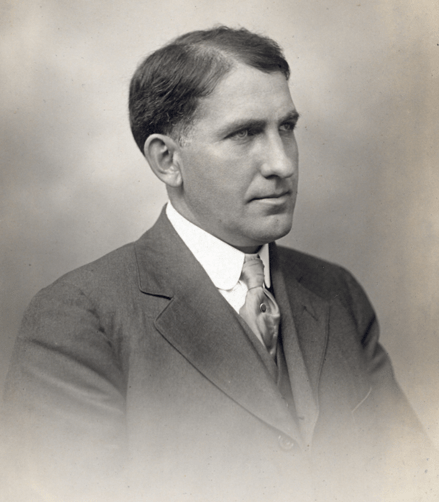
As part of my PhD research, for the past two years I have been looking through the archival papers of Catholic priest, Henri Nouwen, housed at the Kelly Library, at the University of Toronto. For a man who never threw anything away, his archival legacy provides a wealth of information. And like myself, Henri collected research material towards subjects which interested him. Of particular interest to me has been the materials collected by Henri regarding Anton Theophilus Boisen, ordained a Presbyterian minister in 1912, and credited with being the founder of the clinical pastoral education movement. Importantly, Boisen believed that the first-hand study of human experience ought to be a catalyst for thinking theologically for those involved in pastoral ministry. Boisen was an interesting character, having worked for most of his life in mental institutions, and who suffered from periods of mental illness himself. It is said that Boisen’s own psychosis become the centre of his own identity, and Henri described him as a man ‘who went through the wilderness of the lost and made his own illness the centre of his life.’
It was Henri’s desire to write a doctoral thesis on Boisen, and the Nouwen Archive holds a number of manuscripts which formed part of his dissertation, but alas it was never completed. What we do find among his archival papers is a splendid article entitled ‘Anton T. Boisen and Theology Through Living Human Documents’ which appeared in the September 1968 edition of Pastoral Psychology, based in part from an interview which Henri had with Boisen in August, 1964. Nouwen wrote in this article: ‘With an amazing sharpness Boisen studied and analyzed his own case and was able to find, time and again, enough distance to formulate the main insights which would guide his future life,’ namely ‘the essential ingredients of his new approach to theology: the study of “living human documents”.’ A theology based on the study of the human person as a ‘living human document’ became the basis of Henri’s whole life and ministry as well.
An article on Boisen by Glenn H. Asquith Jr. links Boisen’s study of theology through human experience (the living human document), with John Calvin’s understanding of the knowledge of God. Asquith notes that: ‘Calvin believed that true wisdom consists in two aspects: the knowledge of God and the knowledge of the self. These two aspects are inseparable and interrelated. While a person must ultimately seek God, awareness of God may only come through close attention to the condition of the self.’ In his Institutes,Calvin himself wrote: ‘We cannot aspire to [God] in earnest until we have begun to be displeased with ourselves. For what man is not disposed to rest in himself? Who, in fact, does not thus rest, so long as he is unknown to himself; that is, so long as he is contented with his own endowments, and unconscious or unmindful of his misery? Every person, therefore, on coming to the knowledge of himself, is not only urged to seek God, but is also led as by the hand to find him.’ Time and again, in the writing of Henri Nouwen we find this belief, that in the spiritual life, knowledge of God and knowledge of the self are inseparable. Like Boisen, Nouwen believed that the pursuit of ‘theology’ and the pursuit of a ‘spiritual life’ was deepened through insight into the human predicament.
As a spiritual practice, I believe we can take much inspiration from Anton Boisen and Henri Nouwen, both of whom knew what it meant to study oneself as a ‘living human document.’ They both knew that ‘awareness of God may only come through close attention to the condition of the self,’ or to put it another way, until one can have a full relationship with oneself, any relationship with God is, for all intents and purposes, impossible.

 Philip John Bewley