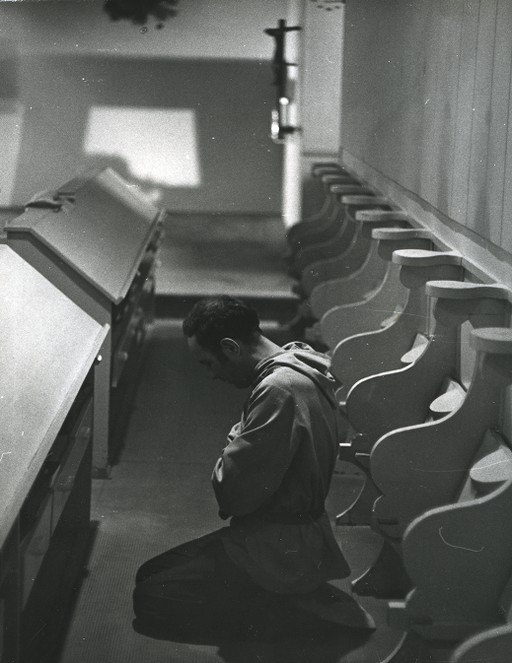
In 1974, at the age of 42, renowned spiritual writer Henri Nouwen spent a seven-month period at the Abbey of the Genesee, a Cistercian monastery in upstate New York, not far from Lake Ontario. The result of his monastic experience was published in his best-selling journal, The Genesee Diary, a book I became familiar with when I first took an interest in the contemplative life. Henri describes in the introduction to his ‘spiritual diary’ the reasons for his request to the Abbot, John Eudes Bamberger, to become a ‘temporary’ monk: ‘My desire to live for seven months in a Trappist Monastery, not as a guest but as a monk, did not develop overnight. It was the outcome of many years of restless searching. While teaching, lecturing, and writing about the importance of solitude, inner freedom, and peace of mind, I kept stumbling over my own compulsions and illusions.’ To his surprise, Abbot John Eudes was open to the idea, and on 1st June Henri’s monastic journey began.
Henri’s desire to enter the Abbey was grounded in the belief that his hectic academic career, and growing success as a spiritual writer needed to have a solid grounding in the spiritual life. As Henri once put it, the spiritual life needs to strike a balance ‘between silence and words, withdrawal and involvement, distance and closeness, solitude and community,’ recognising that ‘a life without a lonely place, that is, without a quiet center, easily becomes destructive.’ Reflecting on Henri’s time at the Genesee, writer Gerald Twomey believed that Henri ‘undertook to stoke the divine fire within himself and sought to enter into the furnace in which inner transformation takes place.’
At the Genesee, Henri undertook the full routine of the monastic life, from the keeping of the Liturgy of Hours, to such manual tasks as baking bread, washing boxes of raisins, peeling potatoes, pressing sheets, handyman tasks, and the collecting of granite rocks for the building of a new monastic church. Life was no holiday at the Genesee, especially for Henri, who found most manual tasks difficult, but the daily routine did allow him to reflect on his relationship with God: ‘Here in the monastery I could look more easily beyond the boundaries of the place, the state, the country, and the continent, and become more intimately aware of the pain and suffering of the whole world, and respond to them by prayer, correspondence, gifts, or writing. I also felt that in this retreat my friends and family came closer to me. I experienced especially that a growing intimacy with God creates an always widening space for others in prayer. I had a real sense of the power of prayer for others and experienced what it means to place our suffering friends in God’s presence right in the center of your heart.’ Ironically, the physical distance which the cloister put between himself, his friends, and the world, brought him closer to his fellow human beings.
One of the most memorable images for the spiritual life which one can easily take away from Henri’s diary is that of a wagon wheel. This image came to him as he was preparing to leave the monastery and return to the academic world from which he came. For Henri, the image of a wagon wheel demonstrated that the closer someone came to God, the closer it brought them to one another, although in life they were travelling on different paths: ‘God is the hub of the wheel of life. The closer we come to God the closer we come to each other. The basis of community is not primarily our ideas, feelings, and emotions about each other but our common search for God. When we keep our minds and hearts directed toward God, we will come more fully “together.” During my stay in the Abbey I saw and experienced how many men with very different backgrounds and characters can live together in peace. They can do so not because of a mutual attraction toward each other, but because of the common attraction toward God, their Lord and Father.’
In the last four years, many of us have witnessed what happens when the basis for a society becomes built on ‘ideas, feelings, and emotions about each other,’ rather than on our ‘common search for God.’ Dare I say, Trump’s version of America came to enshrine such a belief. But Henri, through his monastic experience, suggests a new way – or should I say, an old and tested way. Henri’s image of a wagon wheel offers us a way to place our relationship with one another in context, bringing ourselves closer together despite our differences, while at the same time growing in our common search for God.
The gathering of granite rocks for the construction of the new abbey church was to serve as a metaphor for Henri’s time at the Genesee. ‘During these months a church was built, a new space for God. Is this going to be true for me, too?’ he thoughtfully wrote. But isn’t it just as true that we all need to find new spaces for God in our lives. A prayer which Henri wrote after a second sabbatical at the Abbey (and one which I love) takes up this theme. Perhaps, for those of us who make occasional retreats with various monastic communities around the world, we too can make Henri’s prayer our own:
‘Lord, my stay at the abbey is coming to an end, and in a few days, I will no longer have the support of the regular hours of communal prayer, of the silence of the house, and of the loving care of this beautiful brotherhood [or sisterhood]. I have to move to a busier place … because it is to that active task that you have called me. But I pray that I will keep you in the center of my thoughts, words and actions. I pray that your presence, which I have sensed so strongly here, will also guide my life … but most of all I pray that I will keep taking the time to be with you and you alone.’ Amen.
 Philip John Bewley