Sydney has always put on a spectacular New Year Firework displays. In my opinion it is one of the few things Sydney does better than Melbourne. When the clocks ushered in the 3rd Millennium in the year 2000, I remember watching the coverage on television from my home in Somerset. The BBC crossed live to each major city around the world as each welcomed in the New Year. That year Sydney had outdone itself with its firework display on the Harbour Bridge. At the very end of their spectacular display in 2000, millions of viewers around the world beheld a single word fashioned in a style known as copperplate, emblazoned across the Harbour Bridge. That single word was ‘Eternity.’
That word ‘Eternity,’ written in chalk in the same elegant copperplate, is estimated to have appeared on Sydney’s footpaths over half a million times between 1930 and 1967. It was written by a man named Arthur Stace. Arthur Stace was born in Sydney’s Balmain slum in 1884 and lived a life on the wrong side of the law. But in August 1930, Arthur attended a service at the Burton Street Baptist Church in Darlinghurst. The preacher was a Reverend John Riley, a noted fire and brimstone preacher. Riley shouted from the pulpit, “I wish I could shout ‘eternity’ through all the streets of Sydney!” Recalling that day many years later, Arthur remembered the Rev’d Mr Riley repeating, “Eternity, Eternity.” “His words were ringing through my brain as I left the Church,” Arthur said. “Suddenly I began crying, and I felt a powerful call from the Lord to write “Eternity.” I had a piece of chalk in my pocket and I bent down right there and then and wrote it.”
From that day onwards, Arthur began his unique ministry. Each day he started early, usually before sunrise, and wandered through the streets of Sydney, bending down and writing on the pavement in large, elegant copperplate, ‘Eternity.’ He died in 1967 at the age of 83, having written this one word at least 50 times each day for 37 years. His special ministry was to make us think, not just about living in the here and now, but also what lies ahead for us in the future, in eternity.
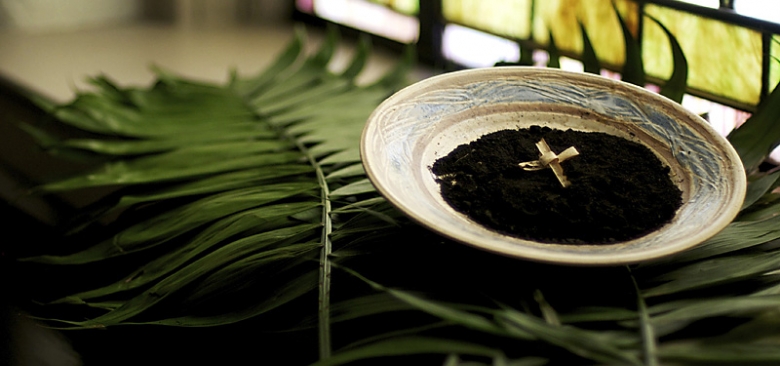
On Ash Wednesday each year, Christians receive a reminder of their own eternity. Ash is placed on our foreheads and we hear the words: “Remember that you are dust, and to dust you shall return.” It is a reminder that this world, beautiful as it is, is not all that there is. Our life might be controlled and dominated by time, but our destiny exists elsewhere in eternity.
Fr Alan Jones, one-time Dean of San Francisco’s Grace Cathedral, says that a friend of his asks his students at the beginning of each academic year, “what truth they want to become by the end of their lives.” Many of us, Jones says, have been telling a story to ourselves, and to the world, for so long, about what we think is real, that we come to foolishly believe that it is absolutely true (and without question).
Lent calls us into the desert experience, to be probed – to think about ourselves in an intentional way, to think about eternity, and the false story we’ve been telling ourselves all our lives. To ask the question: ‘How far is it a lie?’ As Fr Henri Nouwen described Lent: “It is a time to re-focus and re-enter a place of truth.” So, the real question we should be asking ourselves this Lent is this: ‘Is the kind of life we currently lead, a life that will lead us into eternity?’
 Philip John Bewley
Thank you for this Philip! How are you? Mandy
On Wed, Feb 26, 2020, 1:13 PM Philip John Bewley wrote:
> Philip John Bewley posted: ” Sydney has always put on a spectacular New > Year Firework displays. In my opinion it is one of the few things Sydney > does better than Melbourne. When the clocks ushered in the 3rd Millennium > in the year 2000, I remember watching the coverage on te” >
LikeLike