It is always said that when hosting a dinner party, one should never talk about politics, religion or sex, at least not if you want to keep your friends. Yet often these three subjects find their way into the conversation. So here is an all too common scenario.
The argument at the dinner party becomes rather heated over the subject of whether or not one should involve their children in a religious faith. The major consensus is that it is a bad thing. And don’t we hear this argument regularly, that we must not pass on to children what we believe, in case we are brain washing them, by limiting their freedom to choose. “So are you adverse to all knowledge, or just that which includes the name of God?” would be my retort at such a dinner party.
But I’m sure the furor which would ensure after such a question would be fervently reiterated by all those present (apart from me) that this is not a debate about knowledge, but about one involved in the inflicting of views. However, I would argue, “Don’t we do this all the time? Pass on what we know and believe to be true, in all spheres of our lives, especially related to what we hold dear – relationships, morals, etc.? And don’t we want our children to be part of something greater than themselves, providing a structure for living? Why should we not offer them preparation, a springboard from which to proceed, in matters of belief? Isn’t it our responsibility to offer a framework for moral guidance, and a support system? Then let them decide in maturity whether or not they wish to continue within it?”
Well, I suspect a deep silence would follow such a statement, and hang in the air like some thunderous cloud. Then someone would suddenly remember their babysitter, the rest would look at their watches, and there would be noises that it is time to go as it is late.
Our present age creates ambivalence about faith which some people are fearful of addressing.
I’ve often been asked, especially when I was a priest, “How can someone of your intelligence believe what you believe?” to which my usual reply is, “How can someone of your intelligence not believe in anything?”
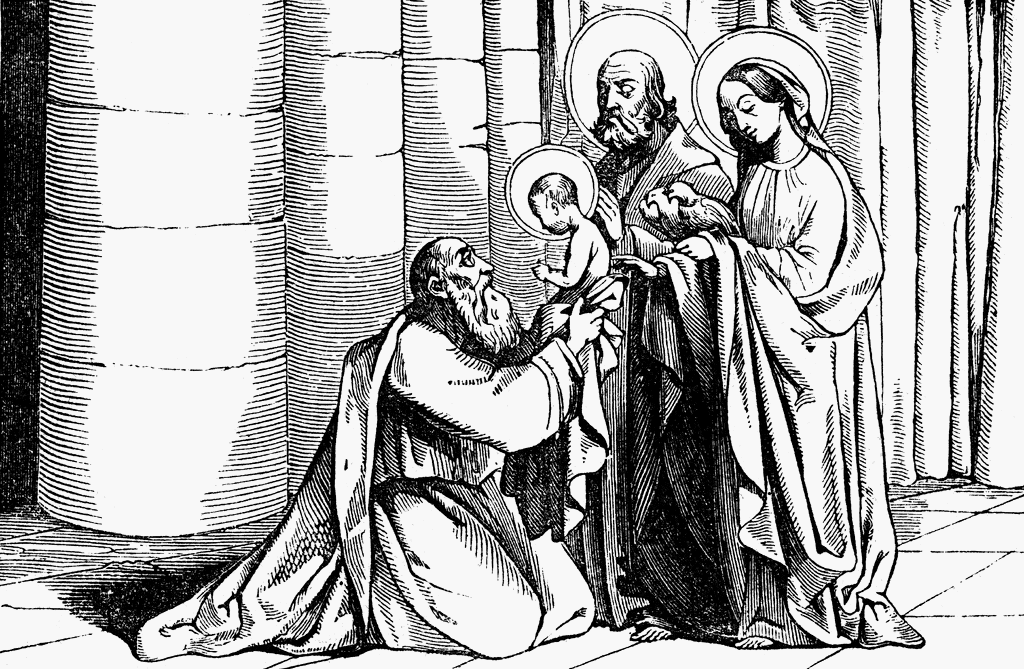
Yesterday the Christian Church celebrated the Feast of the Presentation of Christ in the Temple, commonly referred to as Candlemass. The Gospel set for this feast (Luke 2:22-40) is a rich and beautiful story which helps us to understand the depth and richness of the Christian faith – of honouring God, recognizing the value and need for tradition, the need for membership of a community, and Jesus’ place within all of them.
Jesus was a Jew, of Jewish parents, with Joseph’s heritage recorded as far back as King David. He was part of a religion based within a community of worshippers, and part of a tradition which had rules for membership, some of which were brought into the church, but Jesus lived and died a practicing Jew. As a child, Jesus’ parents offered him a springboard from which to proceed, especially in matters of belief. Then in his maturity, he took that foundation and tradition, thought wisely for himself, and decided to continue within it.
 Philip John Bewley