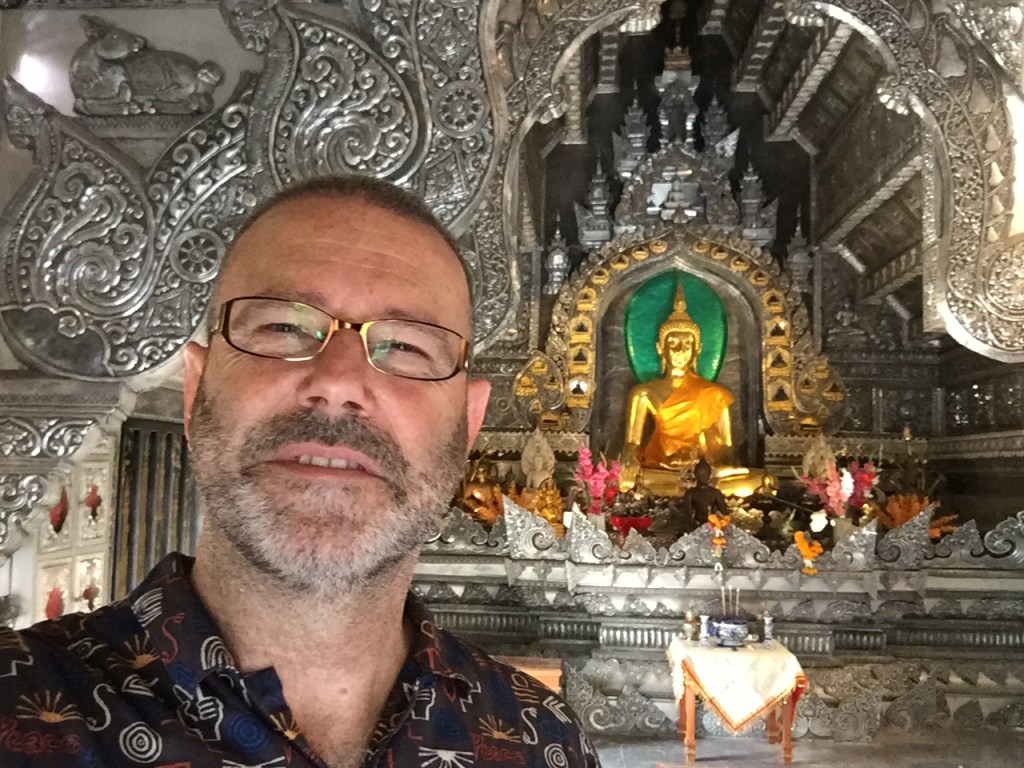
Currently I am holidaying in the beautiful capital of northern Thailand, Chaing Mai, which has around 300 temples or ‘wats’ scattered around the old city and surrounding area. Certainly, the practice of Buddhism is very much an essential part of Thai culture, apparent from the number of locals found offering devotions in the various temples I have visited. It is a timely reminder just how secular we are in Australia where religion of any kind is not a visible part of our everyday life.
There are estimated to be around 300,000 monks living in Thailand. Apparently, every male in Thailand is required to become a monk for a period of time before the age of 20, and although the length of a monk’s internship is expected to last three months, the majority only remain monks for just a few weeks. Young men do this in order to receive good karma and gain merit.
For the westerner, the question often arises whether Buddhism is a religion or a philosophy, particularly as the Buddha was no god, and the keystone of the Buddhist way is personal and spiritual development. Therefore, despite what one might think they are witnessing in temple rituals, the Buddha is not worshipped, but honoured, much like many Christians honour the saints, and the Buddha provides a role model in the practice of the spiritual life. While religious traditions of the West are best characterised as belief systems, Buddhism, I believe is best described as a philosophy, or perhaps even a form of psychotherapy, or an education system.
The Buddha did not receive some privileged, esoteric knowledge, but rather, what he did receive was an awareness of the human condition, defined by the Sanskrit word duhkha (usually translated as suffering), and the way towards its cessation. It was this enlightened knowledge, and the truth he discovered, which gave the Buddha a natural integrity, dignity, and authority to his life.
As a form of teaching, the Buddha presents his findings in the form of a medical diagnosis, including an examination, a prognosis, and a treatment plan, thus defining the Buddha as a healer, not a saviour. Referred to as the cattāri ariyasaccāni or Four Noble Truths, the Buddha’s findings are summed up in just four Sanskrit words: duhkha, trishna, nirvāna and mārga. Duhkha might also be defined as ‘a state of being which is always askew,’ or just plain unsatisfactory; trishna can be translated as ‘cause,’ (the cause of our duhkha being trsnā, our craving and attachment, and avidyā, or our ignorance of such things), while nirvāna is the moment when suffering is extinguished. Mārga is the path leading to nirvāna, which is broken up into a series of component parts, known as the āryāstāngamārga or The Eightfold Path, whose main themes include the cultivation of wisdom, virtue and meditation.
Buddhism offers a timely reminder to any who follow a religious tradition, that a holistic approach is needed for those on the spiritual path, one which provides self-understanding, a greater grasp of our place in the world, and our care for one another. Any healthy relationship is based on a greater understanding of oneself, and I believe this is no less true than with our relationship with God, the wonder and source of our being and human existence.
 Philip John Bewley