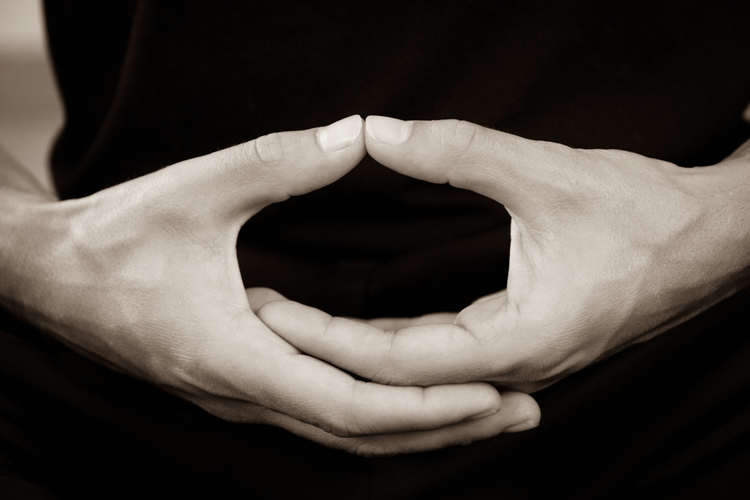
Zazen, which lies at the heart of Japanese Sōtō Zen, is best described as a meditation practice which leads the meditator beyond mere words and concepts. As a spiritual practice, it is inward looking and not about concentration on an object outside of oneself. At first this may set off alarm bells for those of us grounded in the Christian faith. Surely the Christian context of meditation is always to be found (in the words of the late Benedictine monk, Fr John Main) ‘in the fundamental relationship of our lives, the relationship we have as creatures of God, our Creator.’ But where I see zazen being of immeasurable help to Christians is in the preliminary step before this can happen – getting in touch with oneself first. Like any successful relationship we might have with another person, it is no different for a Christian’s personal relationship with God. Until one can have a full relationship with oneself, any relationship with God is impossible. As Fr John Main further explains: ‘Meditation is the very simple process by which we prepare ourselves, in the first instance, to be at peace with ourselves so that we are capable of appreciating the peace of the Godhead within us.’ For the Christian, Zazen practice can be part of that preparation process.
In Mark’s Gospel, Jesus tells us that we need to lose ourselves, to find ourselves (8:35), which is none other than a call to a personal liberation from the ‘false self.’ It was Cistercian monk, Fr Thomas Merton, who popularised in Christian circles this sense of leaving behind the ‘false self’ for the ‘true self.’ He one wrote: ‘At the center of our being is a point of nothingness which is untouched by sin and by illusion, a point of pure truth, a point or spark which belongs entirely to God, which is never at our disposal, from which God disposes of our lives, which is inaccessible to the fantasies of our mind or the brutalities of our own will. This little point of nothingness and of absolute poverty is the pure glory of God in us.’ Merton, therefore, sees our own self-nature, our ‘true self,’ to be none other than God dwelling in us. In this paradox, to find God is to find oneself, and to find one’s ‘true self’ is indeed to find God. Subject and object, therefore, become one, as we come to the realization of our true self nature.
To practice zazen is to bring about a gradual reorientation in the notion of the self. It is to sit with the mystery at the base of the experience. Above all, it is a letting go of all that is false, in order to achieve an expression of what is. And as a spiritual practice, zazen can certainly help Christians move beyond words and conceptual ideas. By letting go of the false self, the Christian moves beyond words and conceptual ideas and is brought to that point of nothingness at the centre of one’s being, where the mystery and peace of God are found, that place where the ‘true self’ lies.
 Philip John Bewley